
Contents:
- Botty in Brief
- How the Botty Trading Bot Works
- Connecting Botty to Hyperliquid
- The User Journey: From Template to Launch
- Conservative, Balanced and Aggressive Strategies
- Spot and futures: two different risk profiles
- Historical Figures for Botty Templates
- What Happens While the Algorithm Is Running
- How the Botty Fee Model Works
- What the DigVel Audit Confirms
- Botty Reviews: What Users Say
- Main Strengths of Botty
- Limitations of the Platform
- Market and Futures Risks to Understand
- Who May Find Botty Relevant
- Final Assessment
Botty is a technology platform that automates the execution of a selected trading strategy according to predefined parameters. It does not forecast prices, send signals or copy other traders. Instead, the Botty trading bot runs a pre-calculated order grid in the user’s own Hyperliquid account, buying in stages as the price falls and closing the position once it recovers above the average entry. This review covers how it works, what users can configure, how Botty earns money, what reviews say and which risks deserve attention.
Botty in Brief
According to Botty’s current documentation, the platform is built for people with capital who want it to work without hours in front of charts and who do not want to become traders. Previous trading experience is not formally required: the core decisions are which asset to use, which template to run and how much capital to allocate.
Botty is not an exchange, bank, broker, investment fund or custodial wallet. It does not accept deposits. The platform is currently integrated with Hyperliquid, and the user’s assets remain in their own account there. Botty acts as a technology layer that executes the chosen strategy.
The founder is Oleksii Ostapovskyi. The September 2026 investor presentation states that the platform launched in March 2026, lists a team of 31 people and reports approximately $3.35 million in capital at work and 214,088 closed trades during the first five months. These figures are company-reported and are not presented as independently verified.
How the Botty Trading Bot Works
The underlying idea is averaging down: if an asset bought at $100 falls to $80, buying a second unit lowers the average entry to $90, so a smaller recovery closes the whole position in profit. The first order uses a small part of the budget. If the price rises by a set step, profit is taken and the cycle restarts. If it falls, the system adds a larger order at a lower level. Once the price returns above the average by the set step, the entire position closes and a new cycle begins.
Unlike a classic grid bot with equal spacing and order sizes, Botty calculates the spacing and size of each order individually, both increasing as the price falls, so the same budget covers a deeper decline. Grids are calculated separately for BTC, ETH and SOL using at least five years of market history.
The model is meant for liquid, fundamentally strong assets, not memecoins. The documentation describes the templates as built around strong crypto assets and equities, so automated stock trading is within scope, although the nine templates in the September 2026 presentation all use BTC, ETH and SOL.
Connecting Botty to Hyperliquid
The connection is authorized through a single wallet signature using Hyperliquid’s official Builder Code mechanism, and Botty receives permission to execute trading operations only. Key points:
assets stay in the user’s own Hyperliquid account and are never transferred to Botty;
Botty has no withdrawal permission, and this restriction is enforced at the exchange level rather than merely promised by the platform;
relevant trading activity on Hyperliquid is recorded onchain, making the trade history publicly verifiable;
the user can stop the automation or revoke access at any moment.
This limits what the platform can do with the account, but “cannot withdraw funds” does not mean “no risk”: the assets’ market value can still decline.
The User Journey: From Template to Launch
Based on the current materials, the sequence is:
Review the available strategy templates for each asset.
Examine the template’s parameters and pre-calculated historical figures.
Connect a Hyperliquid account through a wallet signature.
Select a suitable template or, for experienced users, custom settings.
Choose the capital allocation and, for futures, the split between working capital and reserve.
Press “Launch” to start automated execution.
Monitor filled and pending orders, the average entry and remaining headroom through the interface.
Stop or adjust the strategy within the functions currently available.
With a wallet already set up, the documentation says this takes a few minutes; newcomers get step-by-step instructions, an AI assistant and the support team. Personal assistance is described only for those allocating significant capital.
Conservative, Balanced and Aggressive Strategies
Botty currently offers three categories of ready-made strategies:
Conservative is a spot strategy without leverage, with lower trade frequency and a lower risk and return profile.
Balanced is a futures strategy with a wider grid: fewer trades, but the grid is designed to absorb deeper drawdowns.
Aggressive is a futures strategy with a tighter grid, more frequent trading and higher potential, but also higher sensitivity to sharp market moves.
Experienced users can also build their own settings, according to the documentation.
Spot and futures: two different risk profiles
A spot template buys the real asset into the user’s account. If the price falls below the grid, the user keeps holding the asset; there is no liquidation mechanism, though its market value can decline.
A futures template trades a leveraged contract on the price. With $1,000 and 5x leverage, for example, the position is worth $5,000. This increases potential results, but introduces liquidation risk: if the price moves past the grid without pullbacks and the margin is insufficient, the exchange force-closes the position at a loss.
Botty’s main tool for managing this risk is splitting capital between an active allocation and a reserve. By default, futures strategies launch 50/50, and the reserve cannot be set below 50%. Users can increase it, for example to 40/60 or 30/70, which pushes the liquidation zone further away at the cost of lower potential. Botty shows how the chosen split affects the strategy parameters before launch, and the platform warns the user if the market approaches a stress scenario. A larger reserve reduces the probability of liquidation but cannot eliminate it completely.
Historical Figures for Botty Templates
The current public version of Botty does not include a feature that lets users run arbitrary historical tests with custom settings. Instead, each ready-made template displays pre-calculated historical figures. Before launch, users can see:
results by year and by month across the full data period;
the maximum historical drawdown;
the shortest, average and longest time in a trade;
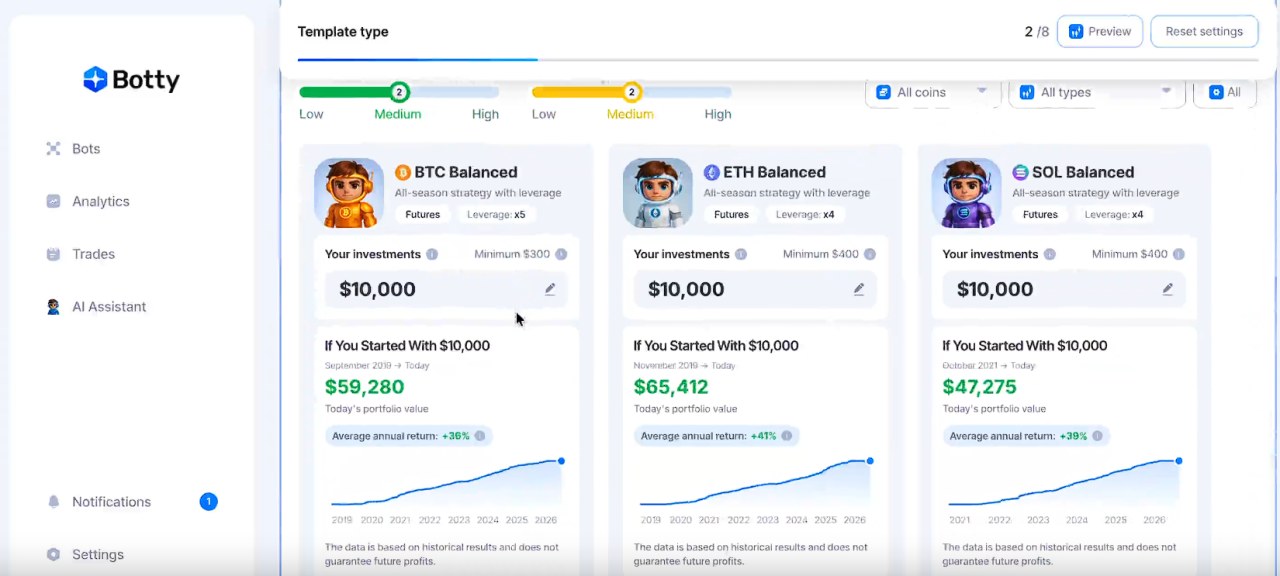
headroom, meaning how far the price can fall before the grid reaches its lowest level;
the grid itself, showing the levels and sizes at which the system will add.
The historical average annual figures shown for Botty’s ready-made templates range from approximately 8% to 58%, depending on the asset, strategy category, parameters and testing period. The table below summarizes the nine templates listed in the September 2026 investor presentation.
These are historical calculations from Botty’s investor presentation, with data running into 2026. They are not forecasts, typical user results or income actually earned by clients.
The presentation’s year-by-year breakdown shows noticeable variation, including a flat year for one Aggressive template. Historical calculations cannot guarantee comparable future results.
What Happens While the Algorithm Is Running
After launch, Botty opens and closes trades around the clock by the template’s rules, realizes results and restarts the cycle; with reinvestment enabled, results are put back to work. The interface shows filled and pending orders, the average entry and remaining headroom. The documentation notes that an open position may stay in drawdown for days or weeks, tying up part of the capital. Trading frequency also depends on volatility: more movement means more cycles, while quieter markets produce fewer.
How the Botty Fee Model Works
Botty uses an activity-based fee. Its charge is incorporated into the Hyperliquid trading fee through Builder Code and applies when the relevant trading operation is executed. If the bot does not trade, Botty does not charge a fee.
Futures: a 0.1% markup on the value of each executed order, regardless of maker or taker status.
Spot: a 0.3% markup on the order value, charged only on sell orders, so once per cycle.
No monthly or annual subscription, no capital-management fee, no fee on results and no withdrawal fee charged by Botty.
The company states that on average 80–90% of the realized result stays with the user, depending on strategy and market conditions. The model is transparent, but on futures templates with frequent trading the per-order markup accumulates, so it is worth considering alongside the template’s trade frequency.
What the DigVel Audit Confirms
Botty underwent an independent security audit by DigVel. According to the How Botty Works document, the audit included penetration testing of botty.com, the certificate is dated April 21, 2026, and the results were published and can be checked through DigVel. The investor presentation adds that all identified issues were closed. Botty also states that it undergoes independent audits regularly as an ongoing practice; that broader claim comes from the platform itself.
The audit confirms that an independent security assessment took place; like any audit, it does not mean all present and future technical risks are eliminated.
Botty Reviews: What Users Say
The main public source of reviews of Botty is the platform’s page on vidhuk.ua, which shows 36 reviews with an average rating of 4.1 out of 5. The sample is small and self-selected, so it describes individual experiences rather than a representative picture.
A recurring theme is time savings. Several reviewers say Botty runs in the background while they work, travel or care for children, and that they now check results weekly instead of constantly.
Reduced emotional interference is another common thread: some users describe past panic selling or chasing hyped coins and say fixed-rule execution made their approach steadier.
Many reviews focus on the non-custodial model: funds remaining on the user’s own balance, permissions limited to opening and closing trades, and the platform’s inability to withdraw. Several users link this directly to their trust in the service.
Users describe results qualitatively as modest, steady or “boring but real”, particularly with Conservative templates. Others mention clear reports, a stable platform and AI assistance. Some note that the product suits a calm, passive approach rather than those seeking high gains. A few older reviews describe the connection method, fees and certain features in terms that no longer match the current product; this review relies on the current documentation for those points.
Several reviewers also describe how Botty fits into everyday routines. One user says he left the bot running during a vacation with limited connectivity, and another reports six months of operation without intervention on a stable platform with a clear dashboard. A user who describes himself as a developer says he examined the logic and that a test grid on ETH behaved as described. Others mention running separate bots within the same household and discussing the results together, or switching from paid signal subscriptions to choosing a template and letting the algorithm execute it. The supplied sample does not establish how widespread these experiences are.
Main Strengths of Botty
Automated execution of predefined rules, reducing the need for constant market monitoring and emotional decision-making.
Three distinct strategy categories with clearly different risk profiles, plus custom settings for experienced users.
Historical figures, drawdowns and headroom visible before launch.
Wallet-signature connection, no withdrawal permission and assets kept in the user’s Hyperliquid account with onchain records.
No subscription and an activity-based fee model.
A documented independent DigVel security audit and an AI assistant to help explain parameters.
Limitations of the Platform
Results depend on market conditions, and returns are not guaranteed.
Users cannot run arbitrary custom historical tests directly in Botty.
The nine ready-made templates in the current presentation cover only BTC, ETH and SOL.
Users still need to understand the difference between spot and futures before choosing a template.
Positions can remain in drawdown for extended periods, and quieter markets mean fewer trading cycles.
Historical figures and reviews have limited predictive value.
Market and Futures Risks to Understand
Automated trading does not remove market risk, and an automated bot is not always profitable. Results depend on market conditions and parameters; historical figures do not guarantee comparable performance. Spot templates avoid liquidation, but asset values can fall. Futures templates use leverage and carry liquidation risk that the reserve reduces but cannot remove. The company advises committing only capital you are prepared to hold through a drawdown. Positive reviews do not guarantee the same experience for another user.
Who May Find Botty Relevant
The Botty format may suit people who hold or plan to hold assets such as BTC, ETH or SOL over a longer horizon, want rule-based execution instead of manual trading, and value keeping control of their own exchange account. The investor presentation frames it around capital with a horizon of 12 months or more. Readers new to leverage, those who need guaranteed or short-term returns, and anyone who cannot tolerate a position staying in drawdown should assess the futures templates particularly carefully, or start with the Conservative spot option.

Final Assessment
Botty offers a clearly defined product: a non-custodial crypto trading bot that automates a calculated averaging-down grid on Hyperliquid, with transparent fees, visible historical metrics and a documented security audit. Its design limits what the platform can do with user funds, but it cannot remove the risks inherent in the market or in leverage. For readers weighing Botty, the most important decisions remain theirs: which template fits their risk tolerance, how much capital to allocate and, for futures, how large a reserve to keep.